
4 Tools That Make SNFY Even More Powerful for Your SNF
Automation on its own does not collect aging AR. It surfaces problems faster, which is a very different thing. A skilled nursing facility can run the best claim scrubber in the industry and still watch a Medicaid pending balance drift past 180 days, because software does not call a payer, chase a DPOA, or file a formal appeal.
That is the thinking behind how MCA pairs SNFY, the first fully automated skilled nursing eBiller, with four hands-on services. SNFY handles the volume. The four tools below handle everything volume cannot reach.
What SNFY Handles on Its Own

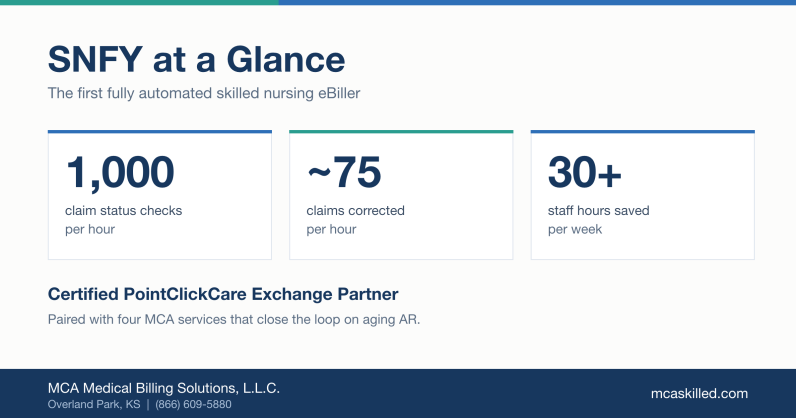
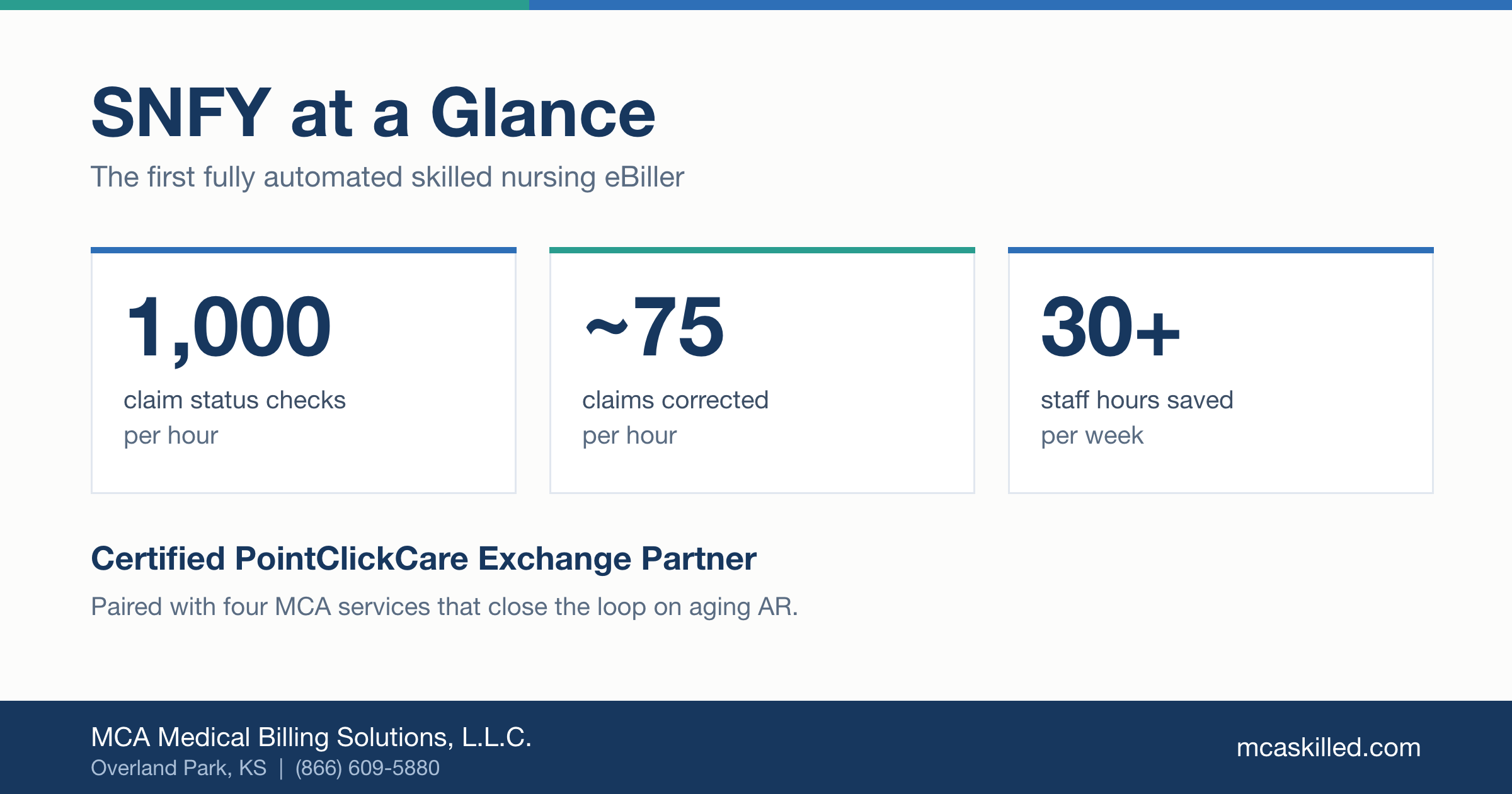
SNFY is a certified PointClickCare Exchange Partner, so it works inside the system your business office already uses rather than beside it. It runs roughly 1,000 claim status checks per hour, corrects about 75 claims per hour, and gives back 30 or more staff hours every week. Its dashboard tracks claim trends, Medicaid pending, AR aging, and census in one view.
What that buys you is time and early warning. Denials surface days sooner than they would under a weekly statusing routine, which matters more than it sounds: a rejection caught on day 7 is a correction, while the same rejection found on day 45 is an appeal.
Tool 1: Text Statements to Residents and Families
Paper statements get opened late or not at all, and every day of delay pushes private pay balances further into the aging buckets. Sending statements by text puts the balance in front of the responsible party the same day it is generated, and reconciling statements before distribution means families are not calling to dispute numbers that were wrong in the first place.
See how this works on the SNF patient billing statements page.
Tool 2: On-Demand Billers

A single biller vacancy at a 100 bed facility can leave roughly $200,000 in aged AR behind within 60 days. On-demand billers are pre-trained on PointClickCare and MatrixCare and deploy within days rather than weeks, with no minimum duration and no benefits burden.
This is the fastest way to clear a backlog, and it pairs naturally with mega-batching: instead of jumping resident by resident, temporary staff work grouped denial reasons in dedicated blocks, which roughly doubles resolution speed. Details on the SNF billing staff page.
Tool 3: Private Pay Collections
Private pay is where facilities most often give up early. A tiered policy fixes that: a first letter at 30 days, a second at 60, then agency referral. One Midwest life plan community used exactly this structure to bring private pay balances from $779,000 down to $267,000 as part of a $990,000 total AR recovery.
More on the PointClickCare private collections page.
Tool 4: RAC Audit Defense
Automation cannot defend a post-payment audit. MCA’s RAD process covers RAC, ZPIC, TPE, CERT, and Medicaid audits through every appeal level, including redetermination, QIC, and ALJ, and it can cover periods billed by a prior vendor. Providence Place has not lost a RAC audit in more than two years under this process.
Full scope on the audit support and write-off review page.
Why the Combination Works

Every AR ledger sits somewhere on a three tier spectrum. The band-aid tier clears a backlog fast, which is what on-demand billers and mega-batching do. The transactional tier installs a rhythm, which is where SNFY and disciplined statusing live: a first status touch on day 7, a second on day 15 after the Medicare 14 day payment floor releases. The preventive tier stops new AR from forming through daily billing logs and daily AR note audits.
One timing rule ties it together. Reworked Medicare claims must go back out by the 13th of the month. Miss that window and the deposit slides into the following month, which is how a facility can fix every claim correctly and still miss its cash target.
Your Checklist
- Run census eligibility checks on the 1st and the 15th to catch mid-month plan changes
- Hold a weekly Triple Check with your BOM, DON, and rehab lead before Part A claims go out
- Log a claim ID, call reference number, and payer rep name on every payer call. No reference number means the call never happened
- Resubmit reworked Medicare claims by the 13th of the month
- Stop resubmitting after a claim is rejected twice for the same administrative error and file a formal appeal instead, well inside the 63 day ceiling
- Audit AR ledger notes daily so front-end rejections never fossilize into timely filing losses
Frequently Asked Questions
Does SNFY replace our billing staff?
No. SNFY removes the repetitive volume work, such as status checks and routine corrections, so your staff spend their hours on the accounts that actually need a human: appeals, Medicaid pending, and payer escalation.
Do we need PointClickCare to use SNFY?
SNFY is built as a certified PointClickCare Exchange Partner, so PointClickCare facilities get the deepest integration. MCA also bills inside MatrixCare, American HealthTech, and Waystar, so facilities on other platforms are still fully supported.
Can we use one of these four tools without the others?
Yes. Each is offered on its own, and temporary or project based support carries no minimum duration. Most facilities start with whichever tier matches their situation: a backlog cleanup first, then the ongoing rhythm.
How quickly should we expect to see AR move?
Measurable progress typically shows in 30 to 60 days. MCA’s Zero AR Initiative goes further and commits to zero AR over 180 days within six months, or the remaining six months are free.
For the bigger picture on replacing an in-house biller with a team, read our guide to SNF billing outsourcing or see how aging AR collections work in practice.
Want to see what SNFY plus these four tools would do to your aging AR? Schedule a free call or call (866) 609-5880.
Author Bio