
FY 2027 SNF Final Rule Takes Effect October 1: What Changed and What Your Billing Office Must Do This Month
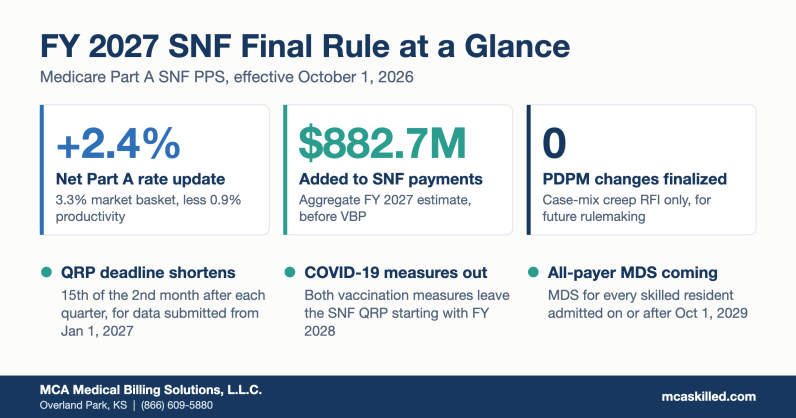
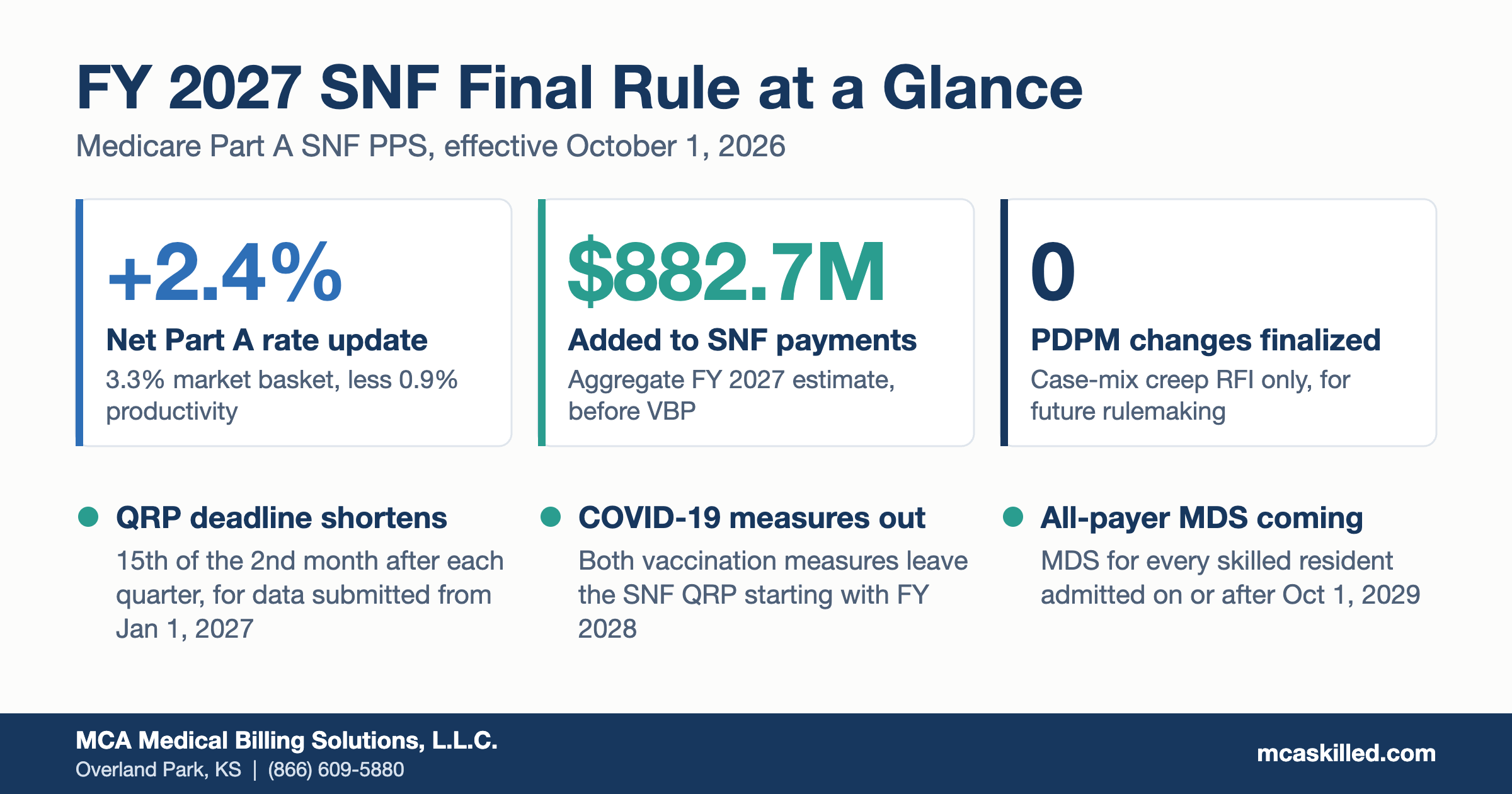
As of October 1, 2026, every Medicare Part A claim your skilled nursing facility submits is priced under the FY 2027 SNF Prospective Payment System final rule. CMS published the rule on July 31, 2026, and the headline is a 2.4 percent net rate update. The details underneath that number are what will decide whether your business office sees the full increase or gives part of it back through the Value-Based Purchasing withhold, stale rate tables, or MDS timing problems that are about to get less forgiving.
This guide covers what actually changed on October 1, what CMS chose not to change, and the specific things a billing office should do before the first October claims go out the door. If you want the short version: the rates moved, PDPM did not, and the MDS calendar is tightening in ways that will matter for the next four fiscal years.
What changed on October 1, 2026
Here is the FY 2027 rule reduced to the items that touch a claim, a rate table, or a reporting deadline.
| Provision | What CMS finalized | When it applies |
|---|---|---|
| Part A rate update | 2.4 percent net increase: a 3.3 percent SNF market basket update less a 0.9 percentage point productivity adjustment. CMS estimates roughly $882.7 million in additional aggregate payments. | Claims with dates of service on or after October 1, 2026 |
| SNF VBP withhold | The 2 percent withhold continues. CMS estimates a net reduction of about $203.6 million across the program in FY 2027 after incentive payments are redistributed. Performance standards are now set for FY 2029 (eight measures) and values published for FY 2030. | FY 2027 payments; standards for FY 2029 and FY 2030 |
| PDPM | No changes finalized. CMS described a framework for addressing case-mix creep and requested feedback for future rulemaking. | No change for FY 2027 |
| Wage index | SNF rates continue to use the hospital IPPS wage index. CMS requested feedback on building an SNF-specific wage index in a future year. | FY 2027 rate tables |
| SNF QRP data deadline | Quarterly submission deadline shortens from 4.5 months to the 15th day of the second month after the quarter ends. | Data submitted on or after January 1, 2027 (FY 2029 QRP) |
| SNF QRP measures | Both COVID-19 vaccination measures (healthcare personnel and residents up to date) are removed. | Beginning with the FY 2028 SNF QRP |
| All-payer MDS reporting | SNFs must submit MDS data for every resident receiving covered skilled care, regardless of payer. | Residents admitted on or after October 1, 2029 (FY 2031 QRP) |
| VBP snapshot dates | Snapshot dates for the MDS-based Discharge Function and long-stay Major Injury measures move to align with the new QRP deadlines. | FY 2027 data |
What did not change: PDPM stays put, for now
The most important non-event in this rule is PDPM. CMS did not adjust the case-mix groups, the variable per diem schedule, or the component weights. What it did do is publish a framework for addressing what it calls case-mix creep, the steady upward drift in nursing and NTA scores since PDPM launched, and ask the industry to comment on it. That is a signal, not a rule. Expect a parity adjustment or a recalibration to appear in a proposed rule within the next cycle or two.
For a billing office, the practical takeaway is that the coding you submit this year is the coding CMS will use to justify whatever it recalibrates next year. Facilities whose MDS coding is defensible, documented, and consistent with the clinical record have nothing to fear from a recalibration. Facilities that have been leaning on aggressive NTA capture without the documentation to back it up should treat this fiscal year as the window to get clean. Our PDPM billing optimization service exists for exactly that: validating ICD-10 and MDS coding against the record before the claim is built, not after an ADR arrives.
Why this matters to your billing office
A 2.4 percent increase sounds simple. In practice, three things stand between the published number and your deposits.
The rate you actually get is facility specific. The market basket update is applied to the federal base rates, then run through your wage index and your case-mix. A facility in a market whose IPPS wage index dropped this year can see less than 2.4 percent, and in some cases a decrease, even though the national headline is positive. Model your own per diem by HIPPS code rather than assuming the national percentage.
VBP gives some of it back. The 2 percent withhold is taken off the top of every Part A claim, and what you earn back depends on your readmission and MDS-based measure performance. Across the industry CMS expects a net reduction of roughly $203.6 million, which means the average facility is not getting the full 2 percent back. Your VBP incentive multiplier for FY 2027 is already fixed; you cannot change it this year, but you can make sure it is loaded correctly in your rate table so remits reconcile.
The annual code update lands on the same day. The FY 2027 ICD-10-CM code set also took effect October 1, and CMS refreshes the PDPM ICD-10 mapping each fiscal year. A 5-day assessment coded with a deleted or remapped code will either return to provider or land in a different clinical category than the one you expected. The mapping file needs to be current in your EMR and your scrubber before October assessments are locked.

The October checklist for SNF billing offices
Work these in order. The first four protect October cash; the rest protect the next three fiscal years.
- Load the FY 2027 rate table by HIPPS code in your EMR and in whatever tool you use for cash projections, with your facility’s wage index and VBP multiplier applied. Do not carry FY 2026 rates into October claims and plan to fix them on the remit.
- Update the PDPM ICD-10 mapping and the ICD-10-CM code set in the EMR and the claim scrubber. Re-run any open 5-day or IPA assessments with an October assessment reference date against the new mapping before they are locked.
- Run Triple Check on the first October Part A batch with the new rates in hand. The pre-billing review of MDS, charges, and compliance is where a rate-table mismatch shows up as a dollar difference instead of a denial. MCA’s PointClickCare Triple Check process is built for this step.
- Bill October claims before the 13th of November. Medicare’s 14-day electronic payment floor means a clean claim released by the 13th is cash in the same month. A claim that waits for a rate correction past the 13th pushes its deposit into December.
- Reconcile the first October remits against the modeled rate. If the paid per diem does not match your modeled per diem for that HIPPS code, one of three things is wrong: the wage index, the VBP multiplier, or the rate table. Find it on the first remit, not the tenth.
- Start the MDS submission clock conversation now. The QRP deadline moves to the 15th of the second month after each quarter for data submitted from January 1, 2027. Q1 2027 data will be due by mid-May instead of mid-August. Ask your MDS coordinator what the current completion-to-transmission lag is and whether it clears 45 days with margin.
- Put all-payer MDS on the capital plan. Every skilled resident admitted on or after October 1, 2029 will need MDS data submitted regardless of payer. If Medicaid and managed care residents are not getting the same assessment discipline as Medicare residents today, that gap becomes a compliance finding in three years.
- Retire the COVID-19 vaccination measure workflows on schedule. They leave the QRP starting with FY 2028, so data collection for those measures can stop once the FY 2028 reporting period closes. Do not stop early; a missed measure is a 2 percentage point APU penalty.
The bigger picture: the MDS is becoming the whole ballgame
Step back from the individual provisions and one theme runs through this rule. Payment (PDPM), quality reporting (QRP), and the withhold (VBP) all read from the same document, and CMS is shortening the time between when that document is completed and when it becomes public and financially binding. A 4.5 month lag gave facilities time to catch and correct MDS errors before they hit a public score. Forty-five days does not.
Layer the all-payer requirement on top of that and the MDS stops being a Medicare document and becomes the operating record for the entire census. Facilities that treat MDS accuracy as a clinical task with a billing side effect will struggle. Facilities that treat it as the front end of the revenue cycle, reviewed weekly with the business office, the DON, and rehab at the table, will find that the same discipline that protects PDPM revenue also protects the QRP annual payment update and the VBP multiplier. That weekly review is the core of what MCA installs at every client through MDS consulting and Triple Check, because clean front-end processes are what create predictable cash flow.

How MCA handles a rate transition for clients
A fiscal year rollover is a scheduled event, so we treat it like one. Before October 1 our billing leads load each client facility’s FY 2027 rates by HIPPS code with the correct wage index and VBP multiplier, refresh the PDPM mapping in PointClickCare or MatrixCare, and re-run the current month’s open assessments against it. The first October Part A batch goes through Triple Check with the new rates, is released ahead of the 13th to stay inside the payment floor, and the first remits are reconciled line by line against the modeled per diem. Any variance is worked in a single batch rather than claim by claim, which is how a rate-table problem gets fixed in a day instead of bleeding across a quarter.
Clients see the result in their AR presentation two to three business days after month close: October Medicare A cash at the new rate, zero rate-related denials, and a current-month aging bucket that looks the way it did in September. For facilities that are still handling the rollover with one in-house biller, this is one of the clearest cases for a team-based model; our SNF billing outsourcing guide walks through what that transition looks like.
Frequently asked questions
Does the 2.4 percent increase apply to every SNF?
No. It is the national aggregate. Your facility’s actual change depends on your wage index, your case-mix, and your VBP incentive multiplier. Some facilities will see more than 2.4 percent and some will see less. Model your own rates by HIPPS code rather than applying the headline percentage.
Did CMS change PDPM for FY 2027?
No changes were finalized. CMS published a framework for addressing case-mix creep and requested comments for future rulemaking, which is a strong signal that a recalibration or parity adjustment is coming in a later fiscal year. The annual ICD-10-CM code update and PDPM mapping refresh still took effect October 1 as usual.
When does the shorter QRP submission deadline start?
It applies to data submitted on or after January 1, 2027, tied to the FY 2029 SNF QRP. The new deadline is the 15th day of the second month after the end of each quarter, roughly 45 days instead of the previous 4.5 months.
What is the all-payer MDS requirement?
Beginning with residents admitted on or after October 1, 2029, SNFs must submit MDS data for all residents receiving covered skilled care regardless of payer, for the FY 2031 SNF QRP. It effectively makes the MDS the assessment record for the whole census, not only Medicare Part A stays.
What happens if my October claims go out with FY 2026 rates?
The MAC prices the claim from the HIPPS code and dates of service, so the payment will be at FY 2027 rates either way. The problem is on your side: your expected reimbursement, cash projections, and remit reconciliation will all be off, and variances get worked as if they were underpayments. Load the new rate table before the first October batch and the issue never arises.
The FY 2027 rule is live. If your October Part A batch has not been run against the new rates, the new mapping, and a Triple Check, MCA can have a billing lead on it this week. Call (866) 609-5880 or schedule a free call and we will walk your rate table with you before the 13th.
Author Bio