What the OIG’s Pinnacle Audit Means for Your SNF’s PDPM Claims

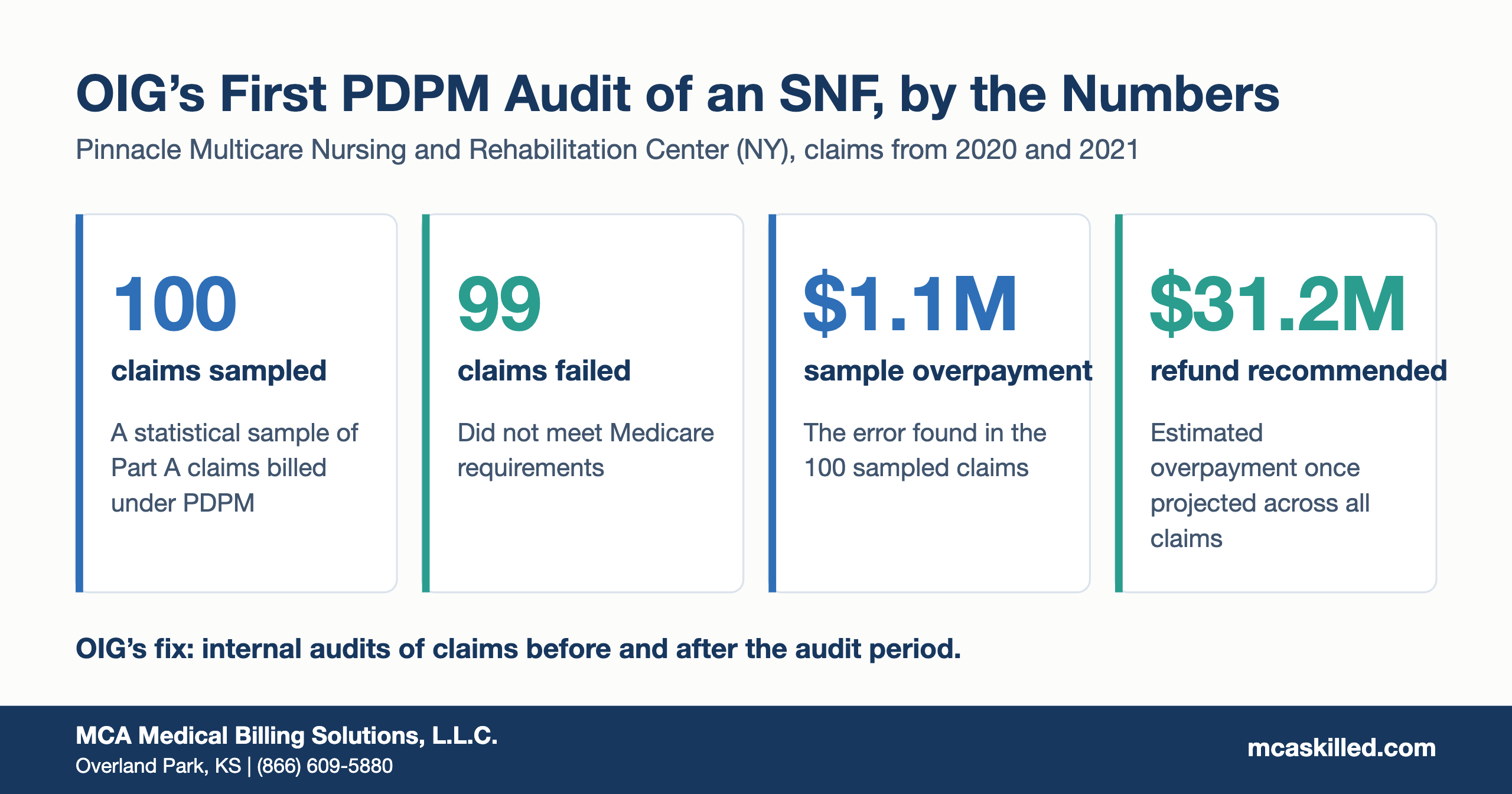
In November 2025, the HHS Office of Inspector General (OIG) published the first audit in its series on skilled nursing facility billing under the Patient Driven Payment Model (PDPM). The facility was Pinnacle Multicare Nursing and Rehabilitation Center in New York. Out of 100 sampled Medicare Part A claims, 99 failed, and OIG recommended a refund of $31.2 million.
It is the first of several. Every SNF billing under PDPM should read this report as a preview of what auditors will look for next, and what they will expect to find in your own files.
What OIG Found
| Item | Result |
|---|---|
| Claims reviewed | Medicare Part A claims billed under PDPM, calendar years 2020 and 2021 |
| Sample size | 100 claims |
| Claims that failed | 99 |
| Overpayment in the sample | $1.1 million |
| Estimated total overpayment | At least $31.2 million |
| Facility response | Did not concur with any of OIG’s three recommendations |
OIG grouped the errors into three categories:
- The record did not support the payment code. The billed HIPPS code was not supported by the medical record.
- The resident did not need skilled care. Claims were billed for residents who did not require skilled nursing services.
- Documentation requirements were not met. The claim lacked documentation Medicare requires for payment.

How $1.1 Million Became $31.2 Million
The errors OIG actually found in its 100 claims added up to about $1.1 million. But OIG did not stop at the sample. Because the claims were selected statistically, OIG projected the error rate across every claim in the two-year audit period. That is how a seven-figure finding became an eight-figure refund recommendation.
This is the part of an audit that hurts most. A high error rate in a small sample does not stay small. The same math applies when a Medicare contractor extrapolates after a TPE or other review.
The Recommendation Every SNF Should Notice
OIG made three recommendations. The first was the refund. The other two apply to every facility billing under PDPM:
- Conduct internal audits of claims from before and after the audit period.
- Train clinical and billing staff on how to properly bill skilled nursing services.
In other words, OIG’s answer to bad PDPM billing is internal auditing. Facilities that are already testing their own claims are doing exactly what OIG told Pinnacle to start doing.
What This Means for Your Billing Office
Each of OIG’s three error categories maps to a check your team can run before a claim goes out the door:
- Payment code support: confirm the billed HIPPS code matches the MDS, and that the MDS coding is backed by the chart. Our PDPM billing optimization work starts here.
- Skilled need: confirm the documentation shows daily skilled nursing or therapy that only a skilled facility can provide.
- Documentation: confirm physician certifications and recertifications, orders and signatures are present and timely.
A strong Triple Check catches many of these issues before billing. An audit tells you whether your Triple Check is actually working.

A Self-Audit Checklist Based on the OIG Findings
- Pull a sample of Part A claims from the last 12 months, weighted toward high-paying HIPPS codes and long stays.
- Compare each billed HIPPS code to the MDS assessment it came from.
- Check the MDS coding for each PDPM component (PT, OT, SLP, nursing, NTA) against the clinical record.
- Confirm daily skilled services are documented for every billed day.
- Verify physician certifications and recertifications are signed and on time.
- Track every error by type and calculate an error rate, the same way an auditor would.
- Fix the process that caused each error, then retest next quarter.
The Bigger Picture
The Pinnacle report is the first in an OIG audit series on SNF reimbursement under PDPM. The series lists eight projects, seven of them still active, so more facility reports are coming. At the same time, facilities with high error rates on the SNF 5-Claim Probe are moving into Targeted Probe and Educate reviews, and recovery audit contractors can look back up to three years.
The facilities that do best in this environment find their own errors first. MCA’s SNF claims audit reviews up to 100 claims the way OIG does and gives you a written findings report. New York facilities can also use it to support their OMIG compliance certification. If the audit uncovers deeper problems, our team can take over with SNF billing outsourcing or audit defense and appeals.
Frequently Asked Questions
What did the OIG find in the Pinnacle PDPM audit?
OIG reviewed a sample of 100 Medicare Part A claims from 2020 and 2021 and found that 99 did not meet Medicare requirements. The errors fell into three groups: the medical record did not support the billed payment code, the resident did not need skilled services, or the claim did not meet documentation requirements.
How did a $1.1 million sample error become a $31.2 million refund?
OIG used a statistical sample. The overpayment found in the 100 sampled claims was projected across every claim in the audit period, which produced the estimated overpayment of at least $31.2 million.
Will OIG audit more skilled nursing facilities under PDPM?
Yes. The Pinnacle report was the first in an OIG series on SNF reimbursement under PDPM. The series lists eight projects, and seven were still active when this was written.
How can my facility find these errors before an auditor does?
Run an internal claims audit. Pull a sample of Part A claims and check each billed HIPPS code against the MDS and the clinical documentation, confirm the resident needed daily skilled care, and verify certifications and orders. OIG itself recommended that Pinnacle conduct internal audits.
Want to know what an OIG auditor would find in your claims? Request an SNF claims audit or call (866) 609-5880.
Author Bio