SNF TPE Audit Readiness: How to Pass a Targeted Probe and Educate Review

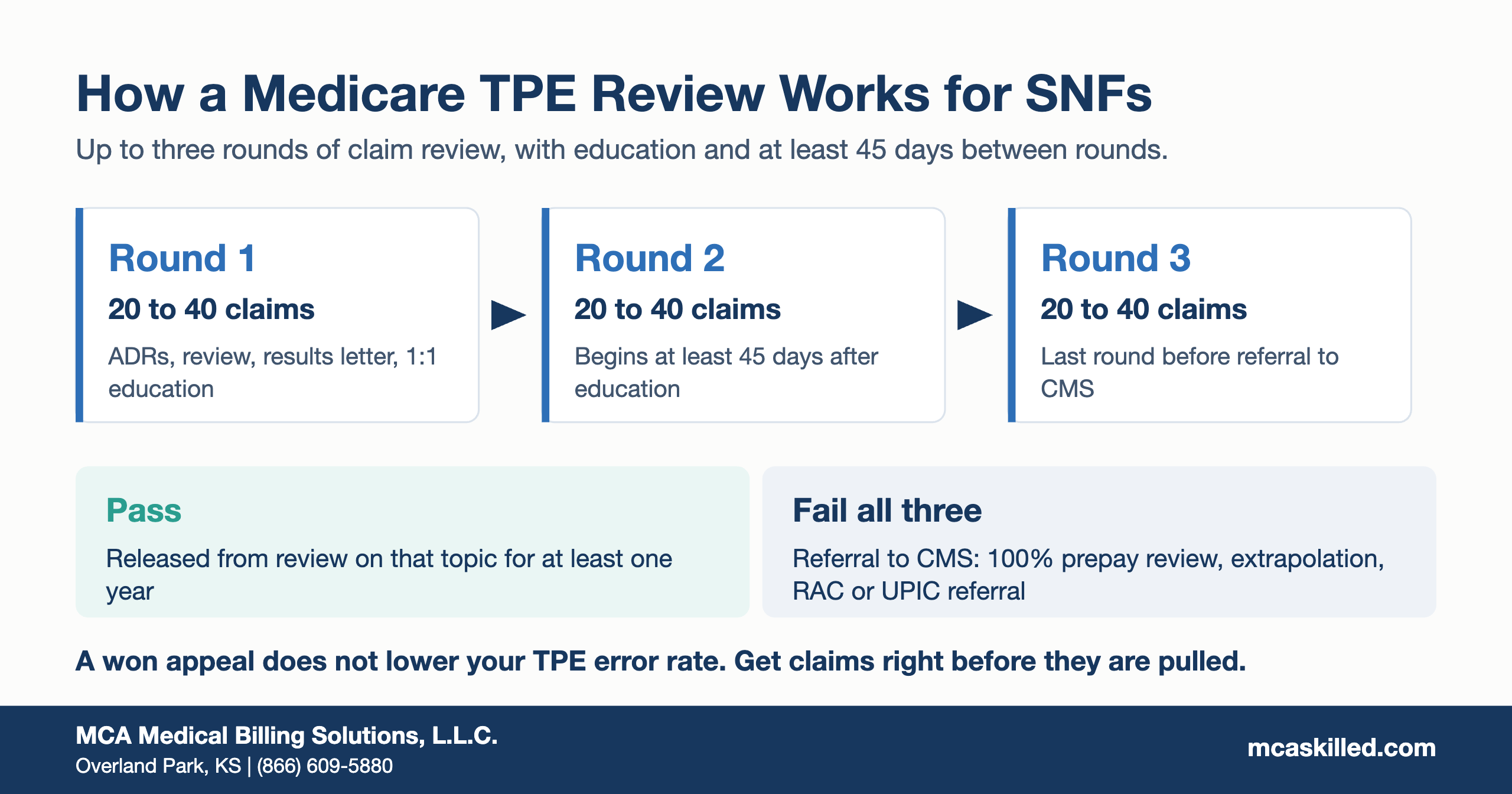
If your skilled nursing facility had a high error rate on the SNF 5-Claim Probe, a Targeted Probe and Educate (TPE) letter may already be on its way. CMS ended the 5-Claim Probe on June 30, 2025, and directed MACs to move facilities with a 100% error rate into TPE, with facilities in the 60% to 80% range prioritized next.
TPE is designed to educate, but the stakes are real. Fail three rounds and the next steps include prepayment review on every claim, extrapolated overpayments, or a referral to a Recovery Audit Contractor. Here is how the process works and how to get ready before the first ADR arrives.
How TPE Works
| Step | What happens |
|---|---|
| Notice and ADRs | Your MAC requests records for 20 to 40 claims. ADRs are generally due 45 calendar days from the request date. |
| Review and results | The MAC reviews each claim and sends a results letter listing errors and the reasons for each denial or adjustment. |
| Education | You are invited to a one-on-one session with a MAC educator. The educator is not the reviewer and does not have your records. |
| Improvement period | At least 45 days to fix the problems before the next round begins. |
| Rounds 2 and 3 | The same process with a new sample of 20 to 40 claims. |
| Pass | Released from review on that topic for at least one year. Facilities that improve significantly can be released early. |
| Fail all three | Referral to CMS for 100% prepayment review, extrapolation, or RAC or UPIC referral. |
The Error Rate Is What Counts
Two details catch many facilities off guard. First, each MAC sets its own error rate threshold and does not have to publish it, so you may not know the passing score until your education call. Second, a successful appeal does not lower your TPE error rate. You can win the money back on appeal and still fail the round.
That makes TPE different from most denials. The goal is not to fight bad claims after the fact. It is to make sure the claims a MAC pulls are already correct and fully documented.

Where SNF Claims Fail
TPE reviewers look at the same things OIG flagged in its first PDPM audit of a skilled nursing facility, where 99 of 100 sampled claims failed (read what the OIG’s Pinnacle audit means for your PDPM claims):
- Payment code support: the billed HIPPS code does not match what the MDS and the chart support. See PDPM billing optimization.
- Skilled need: the record does not show daily skilled nursing or therapy for each billed day.
- Certifications and orders: physician certifications, recertifications or orders are missing, unsigned or late.
- Incomplete ADR packets: the right records exist but were not sent. There is usually little chance to add information after you submit.
A TPE Readiness Checklist
- Assign one TPE point person and log every ADR, due date and submission confirmation.
- Build a standard ADR packet checklist: MDS, physician certifications, orders, therapy and nursing notes, and the claim itself.
- Have a second reviewer check every packet before it is sent.
- Run a Triple Check on every Medicare Part A claim before billing.
- Audit a sample of your own claims now, using the same 20 to 40 claim scale a MAC uses, and calculate your error rate.
- Fix the root cause of each error and retrain staff before the next round.
- Track denial trends by reason so problems are caught between rounds.

Audit Yourself Before the MAC Does
The surest way to pass TPE is to know your error rate before the MAC calculates it. MCA’s SNF claims audit reviews up to 100 of your claims the way a Medicare reviewer would, matching billed HIPPS codes to the MDS and clinical documentation, and delivers a written report of every error and its fix. Facilities already in TPE use it between rounds to confirm the fixes are working.
If you are mid-review or facing denials, our team can also help with audit defense and appeals and ongoing SNF billing outsourcing. For broader preparation, see how to prepare your SNF for a CMS billing audit.
Frequently Asked Questions
How many claims are reviewed in an SNF TPE audit?
A traditional TPE round reviews 20 to 40 claims and the supporting medical records. A facility can go through up to three rounds.
How long do I have to respond to a TPE ADR?
Additional Documentation Requests are generally due 45 calendar days from the date of the request. ADRs can arrive over several weeks or in a batch with one deadline, so track every due date.
What error rate do I need to pass TPE?
Each Medicare Administrative Contractor sets its own error rate threshold and is not required to publish it. The MAC typically shares it during the education session.
Does winning an appeal help my TPE results?
No. A successful appeal can recover the payment, but it does not reduce the error rate used for TPE. That is why getting claims right before they are pulled matters so much.
What happens if my SNF fails three rounds of TPE?
The MAC refers the facility to CMS for further action, which can include 100 percent prepayment review, extrapolation of overpayments, or referral to a Recovery Audit Contractor or UPIC.
Know your error rate before your MAC does. Request an SNF claims audit or call (866) 609-5880.
Author Bio