PDPM Return to Provider Codes: The 33 Diagnoses Still Breaking SNF Claims in FY 2027
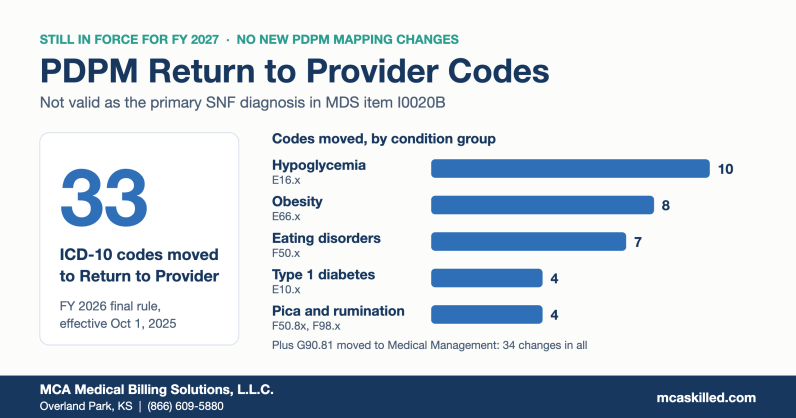
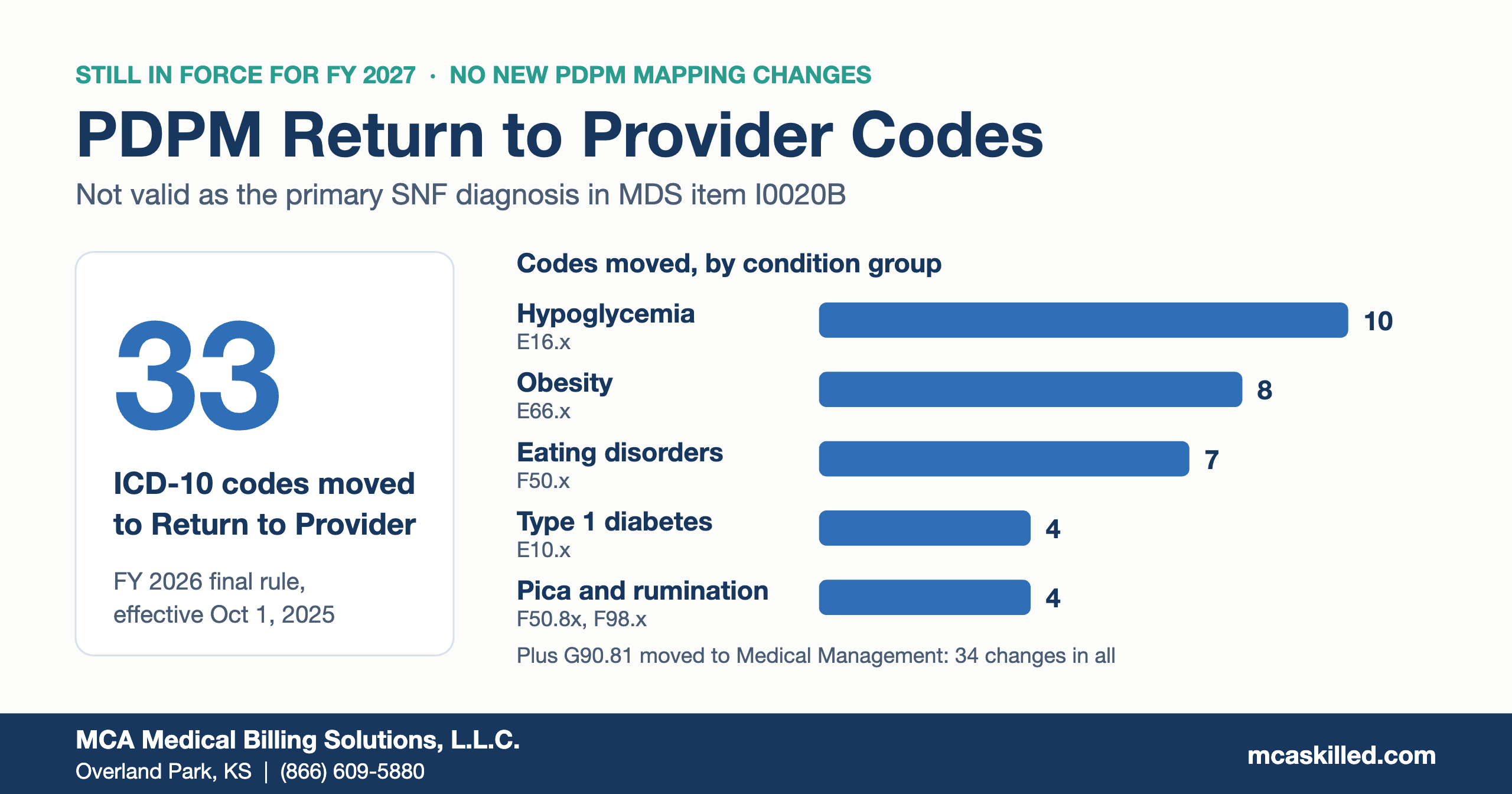
A year after CMS moved 33 ICD-10-CM codes to Return to Provider (RTP) under the Patient-Driven Payment Model, those codes are still turning up as primary diagnoses, and the claims built on them still break. Nothing has changed since: in the FY 2027 SNF final rule, effective October 1, 2026, CMS found no substantive changes to the PDPM ICD-10 mappings. The list that took effect October 1, 2025 is the list your MDS and billing teams are coding against today.
Return to Provider is PDPM’s way of saying: this code cannot be the primary reason for the SNF stay. Use one of them in MDS item I0020B and the diagnosis will not classify the resident into a PDPM clinical category, which means a claim that can’t be built correctly, delayed HIPPS assignment, and avoidable rework at exactly the moment your billing office is trying to get a clean claim out the door.
The 33 Codes That Moved to Return to Provider
CMS finalized the mapping changes as part of the FY2026 SNF PPS final rule, the same rule that delivered the 3.2% net payment update (about $1.16 billion) for FY2026. The stated goal is consistency with current ICD-10-CM coding guidance. In practice, it is a cleanup of codes that describe chronic conditions or behavioral diagnoses that, by themselves, don’t justify a skilled stay.
33 codes moved from Medical Management to Return to Provider, including:
| Condition group | Example codes now RTP |
|---|---|
| Type 1 diabetes | E10.A0, E10.A1, E10.A2, E10.9 |
| Hypoglycemia & other disorders of pancreatic secretion | E16.0, E16.1, E16.2, E16.A1–E16.A3, E16.3, E16.4, E16.8, E16.9 |
| Obesity (all classes) | E66.01, E66.09, E66.1, E66.3, E66.811, E66.812, E66.89, E66.9 |
| Eating disorders | F50.010, F50.020, F50.021, F50.21, F50.22, F50.810, F50.81 |
| Pica & rumination disorder | F50.83, F50.84, F98.21, F98.3 |
One code moved the other way: G90.81 (serotonin syndrome) was recategorized from Acute Neurologic to Medical Management.

Why This Hits the Billing Office, Not Just the MDS Coordinator
An RTP code is not a “banned” code. The distinction matters:
- MDS item I0020B (primary reason for SNF care): an RTP code here fails to classify the resident. This is where claims break.
- Section I8000 and the claim itself: these diagnoses can still be reported as active secondary conditions where clinically appropriate.
So a resident admitted after a hypoglycemic event, or whose Type 1 diabetes is being managed during the stay, doesn’t disappear from your documentation, but the primary diagnosis driving the PDPM classification must be the condition that actually necessitated skilled care. If your admissions and MDS teams were leaning on any of these 33 codes as a default primary, every Part A admission since October 1, 2025 deserves a second look, and every new one still does.
The facilities that feel this most are the ones where coding habits outlive rule cycles. It’s the same pattern we see in denial prevention work: the root cause of a denied or unbuildable claim is almost never laziness. It’s a workflow that nobody re-checked after CMS moved the target.
A 5-Point PDPM Checklist for Your Business Office
- Audit your active Part A census for any resident whose I0020B code is on the RTP list. Reclassify with the correct primary before the next assessment window.
- Cross-check your top 20 admitting diagnoses from the last 12 months against the current PDPM mapping file. If any now map to RTP, brief your admissions and MDS teams this week.
- Verify your software caught up. PCC, MatrixCare and other platforms apply mapping updates on different schedules. Confirm you are running the current FY 2027 mapping file (CMS posts minor updates outside the rule each year), and don’t assume. (We support both PointClickCare and MatrixCare environments.)
- Watch your RTP rejections and unclassifiable assessments as a weekly KPI, not a monthly surprise. They are an early-warning signal for revenue leakage. (More on the numbers worth tracking in our SNF billing KPI guide.)
- Fold this into your triple check. The pre-billing meeting is the last, cheapest place to catch a primary-diagnosis problem before it becomes a denial.

What FY 2027 Did (and Didn’t) Change
For FY 2027, CMS reported no substantive changes to the PDPM ICD-10 code mappings. Minor, nonsubstantive updates were handled outside of rulemaking and posted with the mapping files on the CMS website. Commenters also asked CMS to move two more codes, Z51.A and F01.50, out of Return to Provider and into Medical Management, and to add dysphagia codes to the SLP comorbidity list. CMS deferred those requests to future rulemaking, so Z51.A and F01.50 remain Return to Provider for now.
The bigger FY 2027 items for the business office are the 2.4% net rate update and shorter QRP submission deadlines starting in 2027. We covered those in our FY 2027 SNF final rule checklist, and the operational side in the 2026 SNF compliance checklist.
If your team is stretched too thin to re-audit diagnosis workflows on top of daily billing, that’s exactly the situation outsourced SNF billing is built for: a dedicated team whose job is to keep up with CMS so your building doesn’t have to.
Frequently Asked Questions
What does Return to Provider mean under PDPM?
An RTP code cannot be used as the primary diagnosis in MDS item I0020B. It won’t map to a PDPM clinical category, so the assessment can’t classify the resident for payment. The code can still appear in Section I8000 or on the claim as an active secondary diagnosis.
When did the FY2026 PDPM ICD-10 changes take effect?
October 1, 2025, the start of FY2026. They apply to assessments and claims from that date forward.
Did the FY 2027 final rule change the PDPM ICD-10 mappings?
No substantive changes. The 33 Return to Provider codes from FY 2026 still apply in FY 2027, which began October 1, 2026. CMS also deferred requests to move Z51.A and F01.50 out of Return to Provider.
Can I still code Type 1 diabetes or obesity for an SNF resident?
Yes, as active secondary diagnoses where clinically supported. They just can’t be the primary reason for the SNF stay under PDPM.
How do I know if a claim was affected?
Look for unclassifiable assessments, RTP edits, or default HIPPS codes on Part A claims with admission dates on or after October 1, 2025. An aged claim built on a bad primary diagnosis often surfaces later as a denial. If you’re seeing those, a claim-level AR review will find the pattern.
Need a second set of eyes on your PDPM coding and claims? MCA has specialized in SNF billing since 2003. Talk to our PDPM billing optimization team →
Author Bio