
Case Study - $400K in AR Recovered in 60 Days
The Challenge

Like many skilled nursing facilities, Providence Place was carrying a substantial balance of old accounts receivable, claims that had aged past the point where in-house teams typically have the time or payer-specific expertise to chase them down. Every month those balances sat uncollected, they moved closer to timely filing deadlines and permanent write-offs.
Aging AR is rarely a staffing effort problem. It is a follow-up systems problem: unworked denials, missing documentation requests, payer-specific resubmission rules, and appeals that never get filed.
The MCA Approach: Billing Theory in Action
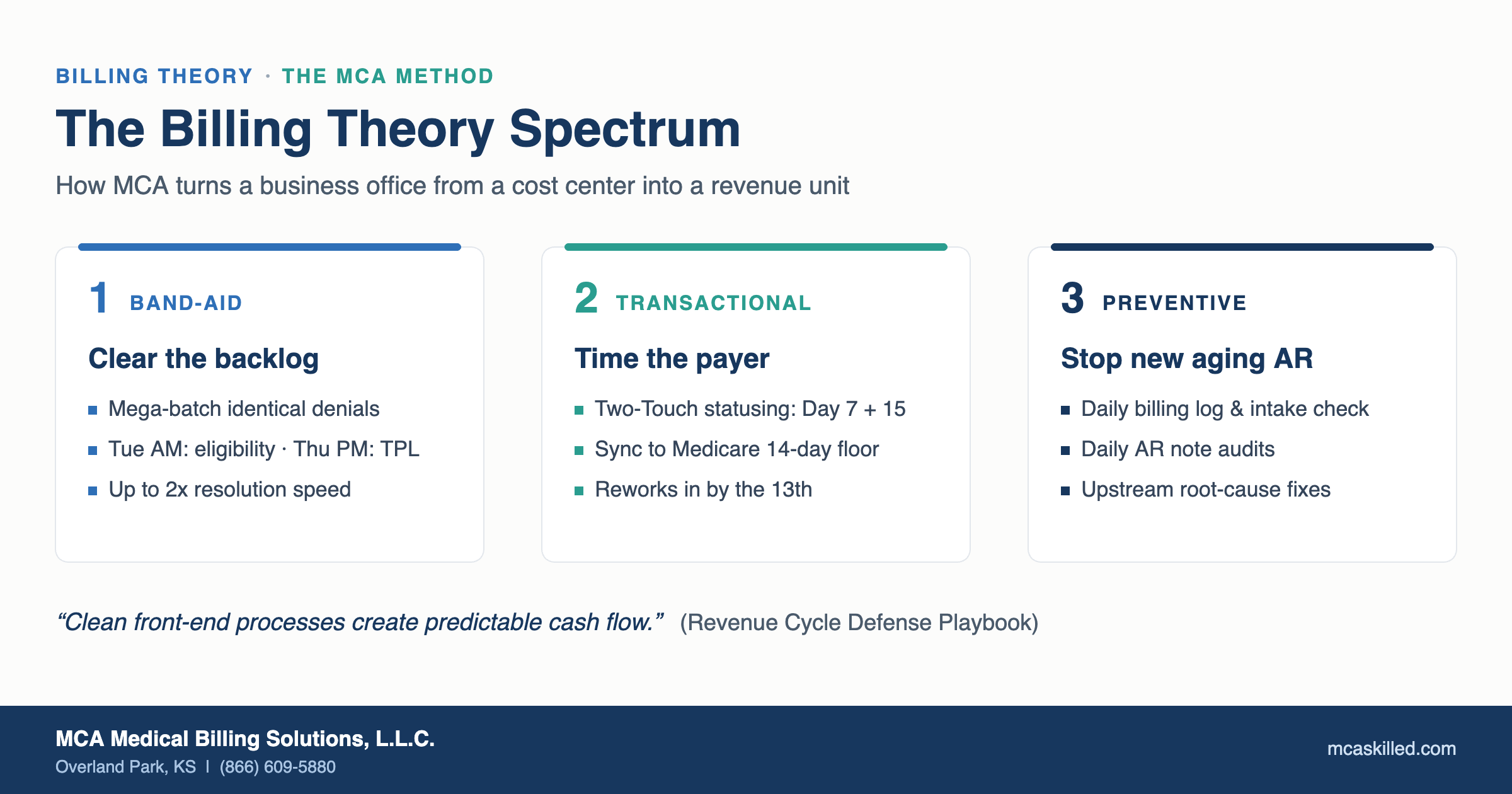
MCA’s billers don’t chase claims randomly. They follow an operating doctrine we call Billing Theory, developed by our Chief Operating Officer, Harrison Cobb. The premise: your AR ledger is a mirror of your clinical and front-office operations, and a turnaround has to work across three tiers: clear the backlog fast, put claim follow-up on the payer’s clock, then stop new aging AR from ever forming. Here is exactly how that played out at Providence Place.
Step 1: A full AR audit, worked oldest-first
Every open claim was segmented by payer, claim status, and aging bucket, then prioritized by dollar value and, critically, by each payer’s timely filing deadline. Claims within 60 days of a filing cutoff went to the front of the line, so no recoverable dollar was lost to the calendar. This is the same AR clean-up discipline we bring to every engagement, tracked claim-by-claim from intake to zero balance.
Step 2: Mega-batching the denial rework
Most business offices work AR resident-by-resident: eligibility, then auth, then TPL, one account at a time. That context switching burns up to 40% of a biller’s day. MCA instead grouped identical denial reasons into dedicated work blocks: commercial eligibility denials in one session, third-party liability conflicts in another. Mega-batching resolves claims up to twice as fast. It is what makes clearing six figures of stalled AR possible in weeks instead of quarters.
Step 3: Timing the payer, not just chasing it
Medicare pays electronic claims on a 14-day payment floor, so every corrected claim was resubmitted before the 13th-of-the-month cutoff to keep cash landing in the current month instead of slipping to the next. Claim statusing followed a two-touch rhythm: a first check at day 7 to catch front-end rejections, a second at day 15 once the payment floor cleared. No passive 30-day waits that blow timely-filing windows, and no wasted hours refreshing portals daily.
Step 4: Attacking the “Big Three” nursing home denials
The backlog concentrated where SNF denials always do: eligibility and plan changes, authorization and medical necessity, and third-party liability conflicts. Each got its Billing Theory fix: census-wide eligibility verification on the 1st and 15th to catch mid-month plan swaps, a weekly Triple Check with the facility’s business office, DON, and rehab team to keep skilled days inside authorization windows, and TPL update filings with termination letters to clear stale policies blocking the primary payer. (More on our approach in denial prevention & recovery.)
Step 5: Appeal-grade documentation on every payer call
Every payer contact was logged in the AR notes with the claim ID, the call reference number, and the rep’s name and timestamp. Our rule is simple: no reference number, and the call never happened. When a claim was rejected twice for the same administrative error, we stopped resubmitting and filed a formal appeal with the call log attached. That documented pressure is why some record reviews ended with the payer owing Providence Place more than the original reimbursement.
Step 6: Preventing the next backlog
Collections that don’t hold aren’t a win. As the old AR came down, MCA installed the preventive tier: a daily billing log confirming every new claim was captured and submitted clean, and daily AR note audits so new rejections were caught in days, never fossilizing into timely-filing write-offs. That’s why the recovery stuck, and it’s the operating standard behind our aging AR collections service and the ZARI guarantee below.
The Results
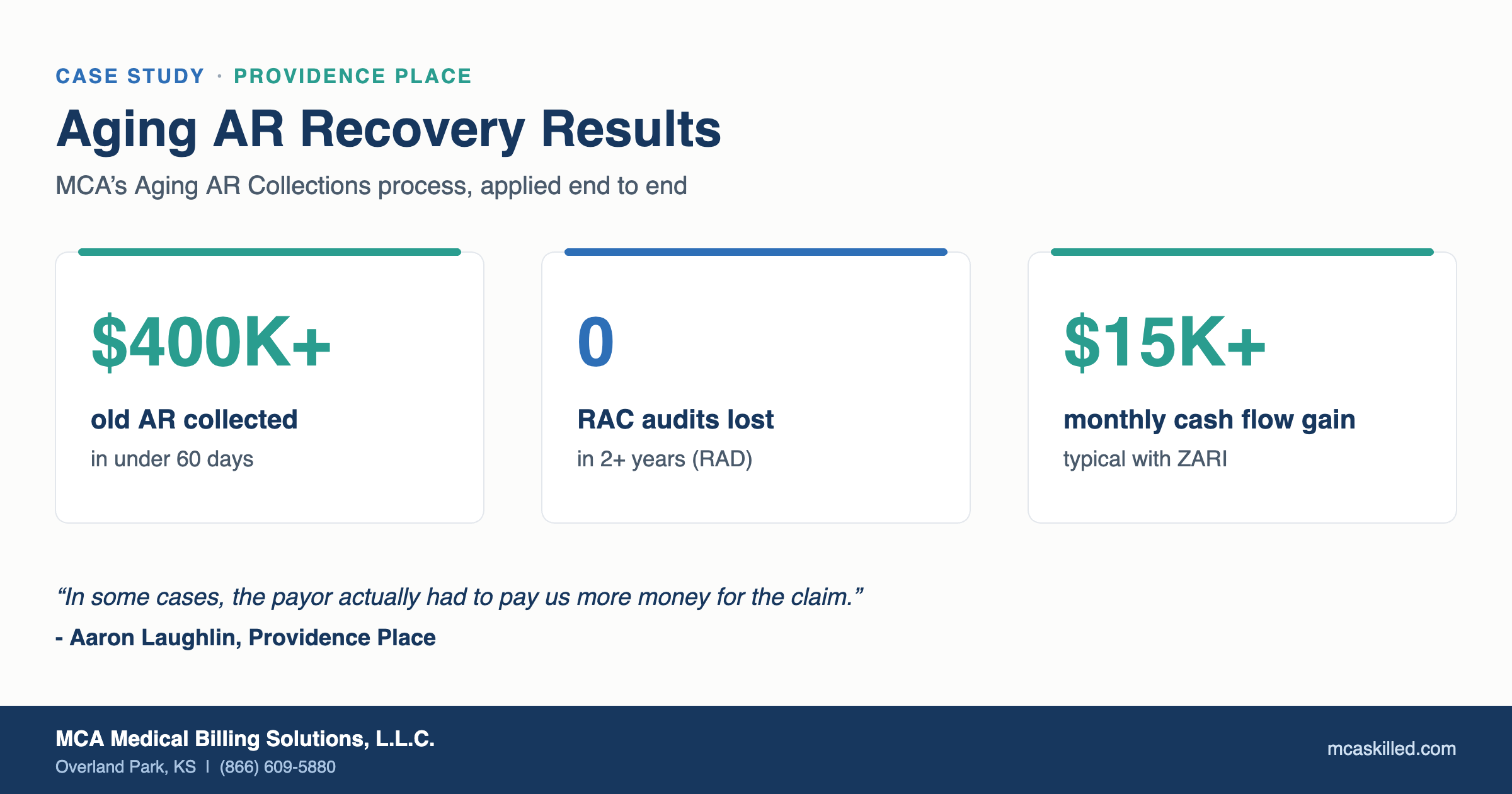
- $400,000+ collected in old AR in less than 60 days
- Zero RAC audits lost since MCA implementation (2+ years) through MCA’s RAC Audit Defense (RAD) process and Audit & Compliance Support
- Underpayment recoveries, in some record reviews, the payer was required to pay more than originally reimbursed
In Their Words
“MCA collected over $400,000 in old AR for us in less than 60 days. Their RAD (RAC Audit Defense) process is phenomenal too. Since they began over 2 years ago, we have yet to lose a RAC audit or commercial insurance medical record review. In some cases, the payor actually had to pay us more money for the claim.”
- Aaron Laughlin, Providence Place
The ZARI Guarantee

Results like these are why MCA offers the Zero AR Initiative (ZARI): collectable AR over 180 days reduced to zero within six months, or we continue working at no cost for the remaining six months. Facilities typically see $15,000+ in additional monthly cash flow within six months. The guarantee only works because the preventive tier holds: once the backlog is gone, the daily billing log and the daily AR note audits keep new claims from ever reaching 180 days. That is the difference between a one time clean-up and a business office that stays clean. Learn more about outsourcing your SNF billing.
Ready to See What’s Recoverable in Your AR?
Schedule a free AR review with an MCA team member. We’ll tell you what’s collectable, what’s at risk of timely filing, and what it would take to get it paid.