
How One Midwest SNF Recovered $990K in Revenue and Cut Aged AR by 76% in Under a Year

Aged accounts receivable is one of those problems that tends to grow quietly. A missed follow-up here, a payer processing issue there, a private pay balance that sits unaddressed for a few months none of it looks catastrophic in isolation. But over time, those gaps compound. The 30-day balances become 60-day balances. The 60-day balances become 90-day. And once AR crosses the 90-day threshold, a significant portion of it is on a trajectory toward bad debt, whether anyone in the billing department is tracking it that way. That was the position one Midwest Life Plan Community’s skilled nursing facility found itself in at the start of July 2025. With $1.683 million in total open AR including $774,000 sitting in the 90-day bucket the facility was looking at a substantial bad-debt exposure that, without intervention, would only get worse.
In less than a year, that picture changed significantly. Here is what happened, how it happened, and what any SNF administrator can take from it.
Where Things Stood in July 2025
The facility is a not-for-profit Life Plan Community in the Midwest offering a full continuum of care, with a skilled nursing operation that generates approximately $1.763 million in monthly receivables across commercial insurance and private pay payers.
When MCA Medical Billing Solutions, L.L.C. began reviewing the AR in July 2025, the numbers told a familiar story. Total AR across all payers was $1.683 million split between $904,000 in commercial and insurance balances and $779,000 in private pay. On the surface, that figure was consistent with the facility’s billing volume. But the aging breakdown was the real concern.
Of that $1.683 million, $774,000 nearly half was sitting in the 90-day bucket. That meant $774,000 in AR was already four months or older, representing dates of service from April 2025 and earlier. The breakdown within that bucket was telling:
- $175,000 in commercial and insurance balances aged 90 days or more
- $599,000 in private pay balances aged 90 days or more
The private pay figure signalled a structural problem. A $599,000 private pay balance in the 90-day bucket is not the result of one bad month. It reflects a pattern of accounts aging without active follow-up a pattern that, left unaddressed, would continue producing the same results regardless of how much new billing the facility generated each month.
The core issue: The facility was generating strong monthly billing volume but lacked the structured AR management processes needed to move that volume through the revenue cycle cleanly. Revenue was coming in, but not fast enough and the gap between what was being billed and what was being collected was widening.
Four Strategies That Changed the Trajectory
MCA Medical Billing Solutions, L.L.C. identified four specific interventions that would address the root causes of the AR aging pattern not just work through the existing backlog but change the underlying process so the same patterns wouldn’t rebuild over time.
1. Structured AR Review Meetings
The first change was also the most foundational: implementing a monthly AR review cadence focused specifically on the highest-risk aging buckets. Balances 60 days and older for private pay accounts and 120 days and older for commercial and insurance accounts were reviewed on a defined schedule, with documented action items and follow-up accountability.
This replaced what is common in many SNF billing operations informal, reactive follow-up that happens when someone has time, rather than proactive, scheduled review that happens because the calendar demands it. The difference in outcomes between those two approaches is significant. Accounts that receive active attention on a regular cycle get resolved. Accounts that receive attention only when someone notices them age into bad debt.
2. Identifying and Resolving Payer Issues
During the AR review process, MCA Medical Billing Solutions, L.L.C.’s team identified a specific operational issue that had been quietly aging a subset of commercial balances without any obvious indication of non-payment. ZELIS a payment processor used by several commercial insurance payers was issuing credit card payments rather than checks for certain claims. Those payments were sitting unprocessed, causing the corresponding AR to age while the actual remittance went unposted. This type of payer-level processing issue is exactly the kind of problem that goes undetected in billing operations without structured AR analysis. The balance ages. The aging looks like slow payment or a payer dispute. By the time someone investigates deeply enough to identify the root cause, months of unnecessary aging have accumulated. Identifying, documenting, and resolving the ZELIS issue unlocked payments that had been stalled and cleared commercial balances that had no underlying collection problem.
3. Medicaid Documentation Coordination with Social Services
The third intervention addressed a revenue cycle vulnerability that is common in Life Plan Community SNF operations but rarely discussed openly: the gap between the social services team and the billing team around Medicaid spending accounts.
When a resident applies for Medicaid at or near the time of SNF admission, their coverage is pending while the application processes. During that window, the account often sits in private pay and if the documentation supporting the Medicaid application is incomplete or delayed, that window stretches. Months of service accumulate as private pay AR with no confirmed payer, aging into the bad-debt risk zone while coverage that would resolve the balance remains pending.
MCA Medical Billing Solutions, L.L.C. increased the frequency of coordination with the facility’s social work team, establishing a more active workflow to ensure Medicaid-eligible residents had complete, accurate, and timely documentation in place. The result was fewer accounts stuck in billing limbo and fewer private pay balances aging for reasons that better clinical-billing coordination would have prevented.
4. A Formal Private Pay Collections Policy
The fourth strategy addressed the private pay aging problem at its source: the absence of a documented, consistently applied escalation process for past-due private pay accounts. Without a formal policy, collections activity depends on individual judgment and available bandwidth neither of which is reliable enough to prevent accumulation.
MCA Medical Billing Solutions, L.L.C. worked with the facility to implement a tiered Private Pay Collections Policy with clear, defined actions at each aging milestone:
- Letter 1 sent to residents or responsible parties with balances 30 days past due a professional billing reminder establishing the outstanding balance and payment expectation
- Letter 2 sent at 60 days past due a formal notice communicating the consequences of continued non-payment
- Referral to a collection’s agency for accounts with no activity or response following the 60-day letter
- Structured follow-up with the collection agency to monitor recovery outcomes on referred accounts
The policy did two things simultaneously: it improved voluntary payment rates by communicating expectations clearly and consistently to residents and families before accounts reached the collections threshold, and it created an accountable process for accounts that did require escalation one that moved forward on a defined timeline rather than waiting for someone to act.
The Results
The impact of the four-strategy intervention was measurable within months. Across every metric, the direction was the same and the scale of improvement exceeded what most facilities see from billing process changes alone.
Total AR All Payers
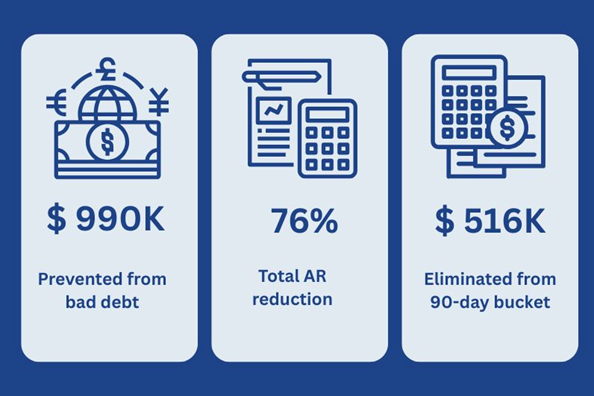
Total AR across all payers dropped from $1.683 million in July 2025 to $407,000 a reduction of $1.277 million, or 76%. Of that $1.277 million recovered, $990,000 came through active billing collections efforts, representing revenue that had been at risk of becoming uncollectible bad debt.
The commercial and insurance portion of total AR declined from $904,000 to $140,000. The private pay portion declined from $779,000 to $267,000. Both improvements were significant, but the commercial reduction driven in part by the ZELIS payment processing issue resolution was particularly sharp.
The 90-Day Bucket Bad-Debt Risk
The 90-day AR bucket the population of balances with the highest bad-debt risk declined from $774,000 to $258,000, a reduction of $516,000 or 67%.
Within that bucket, the commercial and insurance segment declined from $175,000 to $29,000 an 84% reduction. The private pay segment declined from $599,000 to $230,000 a 62% reduction. Both figures reflect the combined effect of the structured AR review process, the private pay collections policy, and the improved Medicaid documentation coordination working together across the aging population.
The bottom line: $990,000 in revenue that was on a trajectory toward bad debt was recovered. A $774,000 90-day AR bucket was reduced to $258,000. Total AR was cut by 76%. And the processes that produced those results are now in place which means the facility is not just in a better position today, but in a structurally different position than it was twelve months ago.
What This Tells Us About SNF AR Management
The specific numbers in this case are significant. But the more instructive takeaway is the pattern they reflect because it is a pattern that appears across skilled nursing facilities of all sizes, in all markets.
The $990,000 recovered was not hidden in complex insurance disputes or unusual billing circumstances. It was in the same places that aged AR accumulates in most SNF billing operations: private pay accounts that weren’t being followed up on a consistent schedule, a commercial payer processing issue that no one had identified, Medicaid pending accounts aging in private pay because of a documentation coordination gap, and a collections escalation process that didn’t exist in writing and therefore didn’t happen consistently.
None of those problems required a sophisticated technical solution. They required process documented, scheduled, accountable process that ensures every at-risk account receives active attention on a defined timeline. That is what MCA Medical Billing Solutions, L.L.C. implemented. And that is what produced the results.
For SNF administrators reviewing their own AR aging data, the question worth asking is not whether these patterns exist in your facility they almost certainly do in some form. The question is how visible they are to your team, and whether the processes currently in place are designed to address them before they reach the 90-day bucket.
Is Your Facility’s AR Aging Moving in the Right Direction?
MCA Medical Billing Solutions, L.L.C. works exclusively with skilled nursing facilities managing every element of the revenue cycle with the SNF-specific expertise and process discipline that consistent billing performance requires. Our ZARI guarantee commits to eliminating collectable AR over 180 days within six months of engagement, or we work free for the remaining six months.
If your facility is experiencing AR aging, growing write-offs, or private pay collection gaps, schedule a free billing assessment with MCA Medical Billing Solutions, L.L.C. today.
Author Bio